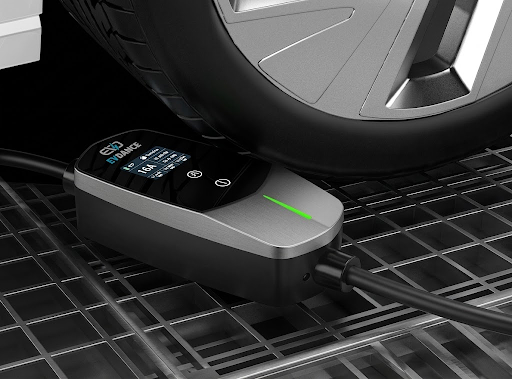

Learn how EV charging timers work, why car and charger schedules conflict, and how to set up reliable overnight charging.
You plug in your EV at 8 PM, expecting charging to begin at midnight. But the next morning, the battery has barely charged.
What went wrong?
Scheduled EV charging can fail when vehicle and charger timers conflict, a delay is misunderstood, or settings are not saved correctly.
Understanding how charging schedules work can help prevent missed overnight charging sessions.
Quick Answer: Why Didn’t My Scheduled EV Charging Start?
Your vehicle and EV charger may have separate charging schedules that do not automatically synchronize.
A delayed-start timer may also be confused with a fixed start time.
Check both schedules, confirm the correct time settings, and use one primary charging timer whenever possible.
What Is Scheduled EV Charging?
Scheduled EV charging allows drivers to choose when charging begins instead of starting immediately after plugging in.
For example, you might connect your EV in the evening and schedule charging for a lower-cost electricity period.
However, two types of timer work differently:
- Delayed Start: Charging begins after a selected delay, such as four hours.
- Fixed Start Time: Charging is scheduled for a specific clock time, such as midnight.
Not every charger supports both functions. Some also allow recurring schedules or departure-time settings.
Always check which scheduling features your equipment provides.
How Does an EV Charging Timer Work?
A typical charging schedule follows four steps.
- Connect
Plug your EV into compatible charging equipment.
- Set
Select the charging time or delay on your vehicle, charger, or supported APP.
- Wait
The system remains ready until the scheduled charging conditions are met.
- Charge
Charging begins when both the vehicle and charger permit it.
A delayed start does not guarantee a full battery before departure. Charging time still depends on available power, battery level, and vehicle settings.
Car Timer vs. Charger Timer: What’s the Difference?
Both the vehicle and charging equipment may control when charging starts.
| Feature | Car Timer | Charger Timer |
| Controlled by | Vehicle software | EVSE or charging APP |
| Main function | Determines when the vehicle allows charging | Determines when charging is available |
| Settings | Vehicle screen or APP | Charger display or APP |
| Potential issue | Vehicle waits for its scheduled time | Charging window may not match the vehicle |
Two independent timers do not necessarily synchronize automatically.
For reliable scheduled charging, understand which device controls the session.
Why Can Two Charging Schedules Conflict?
Imagine this situation:
- Your EV is programmed to start at 2 AM.
- Your charger only permits charging from midnight to 1 AM.
Two timers. No overlapping window.
Example: Midnight to 4 AM
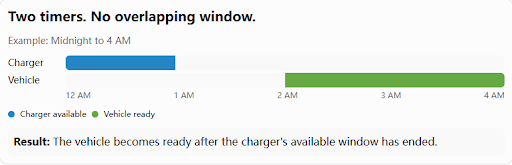
Other possible causes include incorrect clocks, different weekday schedules, unsaved settings, or confusing a delay with a fixed start time.
Use one primary charging schedule whenever possible. If both timers are necessary, ensure their charging windows overlap.
What Are the Benefits of Scheduled EV Charging?
Potential Electricity Savings
If your electricity tariff offers lower rates overnight, scheduled charging may help reduce costs.
Savings depend on the actual tariff and whether charging occurs during the lower-priced period.
Convenient Overnight Charging
Drivers can connect their EV in the evening without returning later to start charging manually.
Better Departure Planning
Charging can be organized around commuting and travel routines, provided enough time and charging power are available.
How Can Drivers Set Up a Reliable Charging Schedule?
Before relying on overnight charging, follow this checklist:
- ✓ Choose one primary timer. Use the vehicle or charger to manage the schedule.
- ✓ Check the timer type. Confirm whether it uses a delay or fixed start time.
- ✓ Check for conflicts. Ensure vehicle and charger schedules are compatible.
- ✓ Verify current settings. Match charging current to the electrical installation.
- ✓ Save and confirm. Check that the device shows the correct scheduled status.
- ✓ Test the schedule. Verify that charging actually starts before relying on it overnight.
If scheduling repeatedly fails, follow the manufacturer’s troubleshooting instructions rather than restarting the equipment indefinitely.
How EVDANCE Supports Scheduled EV Charging
EVDANCE offers portable CEE charging solutions with different scheduling and monitoring features.
Adjustable Delay Timer
Selected EVDANCE 11kW CEE models support a 1–12-hour delayed-start timer.
For example, setting a four-hour delay at 8 PM schedules charging to begin around midnight, provided the vehicle and electrical conditions allow it.
This is a countdown-based function, not necessarily a fixed clock-time schedule.
Smart APP Charging Management
The EVDANCE 11kW Mobile Wallbox with APP supports smart charging management through Wi-Fi and Bluetooth.
Its features include:
- Charging status monitoring
- Delayed charging and scheduling
- Energy consumption information
- Adjustable charging current
- Real-time charging data
The display also provides information about charging current, time, energy consumption, and three-phase voltage.
These functions help drivers understand charging activity and manage schedules more conveniently.
However, APP control cannot automatically resolve every conflict between vehicle and charger timers.
Different CEE Charging Options
Not every driver has the same electrical supply.
EVDANCE offers different CEE charging configurations, including single-phase and three-phase options.
Before choosing a charger, consider:
| Check | What matters |
| CEE socket | Compatible plug type |
| Voltage | 230V or 400V |
| Phase | Single-phase or three-phase |
| Current | Available circuit capacity |
| Timer | Delay or APP scheduling |
| Vehicle | Type 2 and AC charging capability |
Choose the charging solution that matches your vehicle, electrical supply, and scheduling requirements.
Final Thoughts: Make Your Charging Schedule Work
Scheduled charging can improve convenience and potentially reduce electricity costs, but reliable operation depends on compatible settings.
Choose one primary timer, check for conflicts, and verify that charging starts as expected.
For different CEE configurations, power levels, and charging-control features, Explore EVDANCE CEE EV Chargers .
One clear schedule, compatible equipment, and a verified charging start can help prevent an unexpectedly low battery in the morning.